Tuesday, April 19, 2016

The passion of queen ketevan. .... (georgia.part2)

.... ... .   ... .  ...   ... ..  ...... Part.2
After Queen Ketevan was conducted to Shiraz, Brother Ambrose, who was then in that town, entered into contact with her and also with all the members of her household, who numbered about forty. They used to come to Mass at Brother Ambrose's church, and showed a great leaning towards the Catholic religion. Queen Ketevan sent to tell Brother Ambrose that she wished him to confess all her retinue (luring Lent; on the day of his patron saint, St. Augustine, she sent him from her chapel and oratory some pictures, candlesticks and carpets to adorn the church, as well as one of her men who could model wax, to make candles and tapers.
While Brother Ambrose was entertaining great hopes of harvesting the fruit of his fatigues through the conversion of these persons, the King of Persia sent certain of his minions to Shiraz; they were instructed to tell the Georgian queen in his name to become a Muhammadan, and that he would take her as his wife and give her great riches. If she refused, they were to put her to death with great torments. The queen replied that nothing on earth would make her abandon the faith of her Saviour, our Lord Jesus Christ, nor her chastity, which she valued more than all the theatres in the world. The officials begged her again not to expose herself to suffer such tortures, and to have pity on her tender flesh; but nothing could shake her constancy. When they saw this, the officials, after striving in vain to persuade her, told her to prepare to suffer the torments, and she asked for permission to say her prayers. This being granted, she entered her chapel, went down on her knees and prayed our Lord God to accord her His grace, to give her strength to suffer all these tortures for His holy faith.
When she had committed herself to God's keeping she went out and told the minions that they might do what the king had commanded. The officials begged her afresh to have pity on herself a weak woman, and not to condemn herself to so miserable a death. The queen replied that they might give up trying to persuade her, for it was time wasted. The officials had already lit a great fire and inserted iron pincers into it, which were now as hot as the fire itself. They stripped the queen from her neck to her walst, and taking the red-hot pincers, they tore away the flesh from her delicate body with great cruelty, until at last the queen fell half dead to the ground, though continuing to invoke our Lord God with the greatest courage and fortitude. When she had fallen to the ground, they picked up the whole brazier and threw it on her body, anti finally put her to death by strangling her with a bowstring.
It is to he believed that this queen is partaking of God's glory in heaven, for although she belonged to the Greek rite, she was most cordially disposed towards the Holy Catholic Church and to all the Latins, showing them every mark of affection and helping them as much as she could. She lived on such good terms with us that it is impossible to believe that she was ill-disposed to the Holy Catholic Church. A rumour was current among the people of her country that her tomb was enveloped in an aura of shining light. 

The passion of queen ketevan. . (georgia.part2)

 ... . . .   . .. .      Part.1
 During the six centuries which elapsed between the lifetime of the great Georgian Athonites and that of the tragic Queen Ketevan, the kingdom of Georgia underwent great vicissitudes. At the time of the Crusades the inspiring leadership of King David the Builder (1089-1125) and Queen Tamar ( 1184-1213) enabled the country to emerge as leader of a pan-Caucasian Christian empire. But the Mongol invasions of the 1230's, and the later campaigns of Tamerlane, brought all this achievement down in ruins. The fall of Constantinople to the Turks in 1453 cut off Georgia from Western Christendom, and left her a prey to the rising Muhammadan powers Ottoman Turkey and Safavi Iran.
Early in the XVII -th century, Shah Abbas the Great of Persia embarked on a series of campaigns to subjugate Eastern Georgia. He was helped by the defection of Giorgi Saakadze, a prominent general in the service of the young Georgian monarch, Luarsab of Kartli. Saakadze guided the Shah's armies, which vented their fury on Eastern Georgia; churches were devastated, icons and crosses broken up and the jewels given for ornaments to the Shah's concubines. Many people saved themselves by fleeing to the woods and mountain strong-holds, hut at least sixty thousand were massacred. The rest of the population was deported to remote parts of Persia. To quote Pietro Della Valle, a contemporary Italian observer:
"Today Persia proper, Kirman or Carmania, Mazanderan on the Caspian Sea and many other lands of this empire are all full of Georgian and Circassian inhabitants. Most of them remain Christian to this day, but in a very crude manner, since they have neither priest nor minister to tend them. . .. There is no grandee who does not want all his wives to be Georgian, because it is a very handsome race, and the king himself has his palace full of them. . . . It would be too long to narrate all that has passed in this miserable migration, how many murders, how many deaths caused by privation, how many seductions, rapes and acts of violence, how many children drowned by their own parents or cast into rivers through despair, some snatched by force from their mother's breasts because they seemed too weak to live and thrown down by the wayside and abandoned there to be food for wild beasts or trampled underfoot by the horses and camels of the army, which marched for a whole day on top of dead bodies; how many sons separated from their fathers, wives from their husbands, sisters from their brothers, and carried off to distant countries without hope of ever meeting again. Throughout the camp, men and women were sold on this occasion much cheaper than beasts, because of the great number of them."
King Luarsab of Kartli was sufficiently trusting to accept the Shah's offer of peace negotiations; on arriving in the Persian camp he was arrested, and later strangled near Shiraz. The other ruler of Eastern Georgia, Teimuraz I of Kakheti, preferred resistance, and allied himself alternately with the Russians and the Turks to carry on guerrilla warfare.
In revenge, Shah 'Abbas castrated the two young sons of Teimuraz whom he already held as hostages. To the mother of Teimuraz, the Queen Dowager Ketevan, whom he also held in his power, he offered the chance of adopting Islam and entering his harem. On her refusal, she was cruelly martyred at Shiraz on September 22nd, 1624. The following account of her Passion is translated from a contemporary report from the Angustinian missionary fathers in Persia addressed to the Papal See; the original text was first published in 1910 by the late Father Michael Tamarati.

The special one. Nikola Tesla


Monday, April 18, 2016

Quotes by Arthur Schopenhauer Part.2

  1. “To buy books would be a good thing if we also could buy the time to read them.” – Arthur Schopenhauer
  2. “Books are like a mirror. If an ass looks in, you can’t expect an angel to look out.” – Arthur Schopenhauer
  3. “Nature shows that with the growth of intelligence comes increased capacity for pain, and it is only with the highest degree of intelligence that suffering reaches its supreme point.” – Arthur Schopenhauer
  4. “To live alone is the fate of all great souls.” – Arthur Schopenhauer
  5. “There is no doubt that life is given us, not to be enjoyed, but to be overcome –to be got over.” –Arthur Schopenhauer

quotes by Arthur Schopenhauer

  1. Friends and acquaintances are the surest passport to fortune.” – Arthur Schopenhauer
  2. “To marry is to halve your rights and double your duties.” – Arthur Schopenhauer
  3. “Everyone takes the limits of his own vision for the limits of the world.” – Arthur Schopenhauer
  4. “Every truth passes through three stages before it is recognized. In the first it is ridiculed, in the second it is opposed, in the third it is regarded as self evident.” – Arthur Schopenhauer
  5. “The more unintelligent a man is, the less mysterious existence seems to him.” – Arthur Schopenhauer.

Wednesday, April 13, 2016

Final part of hannibal

Then, it is claimed that the elephants either run blindly into corridors left open in the Roman formation for the purpose of directing the animals to harmlessly pass through—Scipio’s alleged “solution” to the problem posed by an elephant charge—or they panicked and turned against Hannibal’s own army, wrecking havoc with his cavalry on the flanks. This also does not hold up against logical scrutiny. Since the animals carried mahouts on their backs, in addition to one or more armed warriors, and the animals were trained to respond to the commands or pressure of their riders, they would surely have been steered to one side or the other to trample men at the edges of any such open corridors. Furthermore, as Haywood (1933) and Scullard (1974) point out, it is not credible that rampaging elephants would do a lot of damage turning against their own side, because the mahouts carried a hammer and chisel to kill any elephant running out of control, as was the case at the battle of the Metaurus (Livy 27:49).  Incidentally, it can also not be argued that these were poorly trained elephants, for if Carthage did not send any elephants with Hasdrubal Gisgo to Utica or to the Great Plains battle, it would have had available all its remaining trained pachyderms, while had the city exhausted its supply there would not have been time, between the Great Plains battle and Zama, to capture and train more.
But it should not surprise us that the elephants at Zama were fictional, for recent research has questioned the very historicity of the battle itself. The reader is referred to Abdelaziz Belkhodja’s book Hannibal Barca: L’histoire veritable as well as to my two previous articles on the battle of Zama up on TheHistoryHerald website. Also recommended is the recent novel by Laura Fernandez-Montesinos, Anibal, El Rayo de Cartago, which brilliantly reconstructs the creation of a hoax for the ages.
 
Elephants at the Battle of Zama

hannibal and elephants Part.9

Then, it is claimed that the elephants either run blindly into corridors left open in the Roman formation for the purpose of directing the animals to harmlessly pass through—Scipio’s alleged “solution” to the problem posed by an elephant charge—or they panicked and turned against Hannibal’s own army, wrecking havoc with his cavalry on the flanks. This also does not hold up against logical scrutiny. Since the animals carried mahouts on their backs, in addition to one or more armed warriors, and the animals were trained to respond to the commands or pressure of their riders, they would surely have been steered to one side or the other to trample men at the edges of any such open corridors. Furthermore, as Haywood (1933) and Scullard (1974) point out, it is not credible that rampaging elephants would do a lot of damage turning against their own side, because the mahouts carried a hammer and chisel to kill any elephant running out of control, as was the case at the battle of the Metaurus (Livy 27:49).  Incidentally, it can also not be argued that these were poorly trained elephants, for if Carthage did not send any elephants with Hasdrubal Gisgo to Utica or to the Great Plains battle, it would have had available all its remaining trained pachyderms, while had the city exhausted its supply there would not have been time, between the Great Plains battle and Zama, to capture and train more.

hannibal and elephants Part.8

All of a sudden, Hannibal, who had only been able to assemble a makeshift army for the final confrontation at Zama, appears with no less than 80 elephants, all with mahouts and trained for battle. This brigade of pachyderms was in all likelihood a fabrication of the pro-Roman historians, a bit of propaganda to make Scipio’s victory appear more formidable and impressive. No serious military historian today believes in that number, as Richard Gabriel shared in a private communication. Perhaps instead of 80, there were 18, or maybe only eight, or, most probably, none.
The charge of the presumed elephants supposedly opens the battle, but we are told that they were frightened by loud noises, shield clashing, trumpets, and what not. This also does not make much sense. Ancient battles typically started with loud yelling, shield banging, and other forms of intimidation, and consequently a major part of the training of animals to be used in attacking enemy positions would have consisted of accustoming them to such sounds.

hannibal and elephants Part.7

We must first ask, how many elephants did the city of Carthage, which did not support a regular standing army, maintain? If the Carthaginians had a large supply of trained war elephants at hand, it would have made sense for them to send along a sizeable contingent of pachyderms, the tanks of antiquity, with Hasdrubal Gisgo, when he marched to stop Scipio’s invading force surrounding Utica. But we do not read Roman reports of any elephants, not a single solitary one, accompanying Hasdrubal’s forces. But surely, after Scipio’s treacherous sneak attack in the middle of the night, burning the tents of Hasdrubal’s unsuspecting soldiers lulled into complacency with a promise of peace, the Carthaginian senate would have ordered all its available war elephants to march to face the ruthless enemy at the decisive battle of the Great Plains that followed. Once again, the elephants are conspicuous by their absence. Naturally, all we have are the Roman accounts—the work of the Carthaginian historians are no longer extant, having been conveniently lost or intentionally destroyed in the burning of Carthage and its libraries in 146 BCE.

hannibal and elephants Part.6

Elephants participated in only one of the great victories of Hannibal following the crossing of the Alps: the battle of the River Trebbia, in 218 BCE. Most of the elephants died of the cold that winter, and none took part in the later battles of Lake Trasimene or Cannae.
The one battle in which Hannibal supposedly did have a large number of elephants was that of Zama, in 202 BCE, where Polybius and Livy claim that he fielded no less than eighty! But, as we will see, this pachyderm battalion may have been fictitious, like most of the description of what the classical sources claim transpired at Zama, as was demonstrated in a 2007 article appearing in the International Journal of the Humanities.

HANNIBAL'S ELEPHANTS Part.5

Two things are clear from such sublime piece of nonsense: neither Polybius nor Livy knew much about elephants, and their histories include fanciful fabrications presented in careful detail, as if related by actual witnesses—caveat lector. What neither classic historian was aware of is that elephants not only are not terrified of rivers, but can swim and are actually very good swimmers! The aquatic prowess of pachyderms would have been well known to the Carthaginians, who had been training elephants for more than a century prior to the wars with Rome. Consequently, it is highly unlikely that Hannibal would have attempted such complicated and unnecessary procedure to get his animals across the Rhone. The Romans, on the other hand, and even the Greeks, would have been less likely to be cognizant of such matters—Livy and Polybius were clearly uninformed.
A Swimming ElephantThe modern reader can enjoy stunning photographs of swimming elephants in Steve Bloom’s Elephant (Chronicle Books, 2006), or view a sampling by doing a Google search for “swimming elephant pictures.”

HANNIBAL'S ELEPHANTS Part.4

                                                    Polybius and Livy claim that barges had to be built to ferry the pachyderms over the Rhone, because the animals were terrified of the water. Large rafts were constructed and connected to ramps that were covered with dirt so the animals would not realize that they were not treading on solid ground, and female elephants were used to lead others onto the rafts. Once each raft was released, being towed to the opposite bank by small boats, the elephants tended to panic, some falling overboard. Fortunately they did not drown, for they were able to walk on the riverbed, using their trunks as snorkels, and eventually all 37 elephants were successfully assembled on the other shore. The elephants’ crossing of the Rhone was the subject of a well-known painting by Henri-Paul Motte showing elephants on barges being pulled across the river.

HANNIBAL'S ELEPHANTS Part.3

                
On his way to the Alps, in 218, Hannibal had to cross first the Pyrenees and then the river Rhone. It was there that a second event involving elephants took place. Polybius (as well as Livy, who largely copies Polybius in the description of this incident) tells us that the Carthaginian crossing was opposed by a large mass of Celtiberian warriors of the Volcae tribe, waiting at the opposite (eastern) shore. What followed was the battle of the Rhone, where Hannibal’s glance was once more in evidence. He sent his lieutenant Hanno with part of his force upstream to ford the river and attack the Celtic tribesmen from the rear by surprise, after giving a signal to coordinate the crossing by his main force. Caught between Hanno’s cavalry and the Carthaginian army the undisciplined warriors fled in disarray. But an interesting problem remained: how to get the elephants across the river.

HANNIBAL'S ELEPHANTS Part.2


For some time the Romans, alarmed by the prosperity and success of the Carthaginians in Spain, were preparing the ground for a renewal of hostilities against their rivals in the Mediterranean. The Ebro treaty had been signed with Hasdrubal the Handsome in 226 or 225, in which the natural boundary of the river Iber (today’s Ebro) was set to separate Roman and Carthaginian spheres of influence, with the Carthaginians agreeing not to cross the Ebro in arms. In violation of the spirit of the accord, Rome subsequently signed an agreement with the city of Saguntum, south of the Ebro and thus within Carthaginian territory, and later encouraged the Saguntines to massacre the Carthaginian partisans in the city and to attack the Turboleti, who were allies of Carthage. Hannibal responded by laying siege to Saguntum and taking it by storm after eight months, during which time the Roman help repeatedly requested by the Saguntines failed to materialize. The fall of Saguntum in 219 provided Rome with a casus belli to declare a new war against Carthage. The Roman navy controlled the Mediterranean, following the defeat of Carthage in the first war, and thus the Romans were not concerned about being attacked by sea. Since the Italian peninsula was protected against an invasion by land from the north by the impassable natural barrier of the Alps, they were confident that the war would be fought in Spain and in North Africa, the land of their enemies. They didn’t count on the genius of Hannibal, the master of the unexpected.  Making a bold strategic decision, he decided to take an army over the Alps and strike from the north against his unwary adversaries. This amazing feat still reverberates in the pages of history.

HANNIBAL'S ELEPHANTS Part.1


Pachyderms are an inseparable part of the image of the great Carthaginian general, Hannibal Barca, although they took part in a lot fewer engagements than most people familiar with his story assume. But let us examine three incidents involving elephants in order to evaluate the accuracy of the classical sources.
In the Summer of 220 B.C.E. Hannibal fought his first major battle, not against the Romans, but facing instead the combined forces of three Celtiberian tribes in northwest Spain, the Olcades, the Vaccaei, and the Carpetani. At the time, the young Punic general was fresh from having been appointed commander-in-chief of the Carthaginian army in Iberia following the assassination of his brother-in-law, Hasdrubal the Handsome, the previous year.  He was returning from a successful campaign against the Vaccaei and the capture of their chief city, Hermandica, when the combined Celtiberian forces of the three tribes, numbering close to 100,000, descended upon him to block his way and annihilate his much smaller army. Here Hannibal’s gaze manifested itself for the first time. With an instant grasp of the terrain, the quality of the large but undisciplined opposing army, and the potentials of all the components of his own military force, he swiftly retreated across the Tagus river and waited for the enemy to attack from the other shore. Notice that his elephants, all 40 of them, had no difficulty in rapidly wading across the river and being deployed on both sides of the Carthaginian formation. Once the pursuing Celtiberians were midstream, and thus committed to the crossing, Hannibal unleashed his cavalry to cut them down in the water, with anyone who managed to reach the shore being promptly trampled to death by the elephants. The mass of tribal warriors panicked and as they fled Hannibal gave the order for his army to cross the river in pursuit, completing the rout of a force more than twice the size of his own. The battle of the river Tagus offered a premonition of what was 

Tuesday, April 12, 2016

History of georgian kings Part.6 David The Builder IV


Muslim powers became increasingly concerned about the rapid rise of a Christian state in southern Caucasia. In 1121, Sultan Mahmud b. Muhammad (1118–1131) declared a holy war on Georgia and rallied a large coalition of Muslim states led by the Artuqid Najm al-din El-ğazi and Toğrul b. Muhammad. The size of the Muslim army is still a matter of debate with numbers ranging from fantastic 600,000 men (Walter the Chancellor’s Bella Antiochena, Matthew of Edessa) to 400,000 (Smbat Sparapet’s Chronicle) to modern Georgian estimates of 100,000–250,000 men. Although all these numbers are exaggerated, all sources agree that the Muslim powers gathered an army that was much larger than the Georgian force of 56,000 men. However, on 12 August 1121, King David routed the enemy army on the fields of Didgori, achieving what is often considered the greatest military success in Georgian history. The victory at Didgori signaled the emergence of Georgia as a great military power and shifted the regional balance in favor of Georgian cultural and political supremacy.

History of georgian kings Part.5 David The Builder IV

                                                  
The Qipcaqs were immediately put to use. In 1120, King David twice invaded and defeated Shirwan, then captured the fortresses of Kabala, Kurdevan, Lizan, and Khishtalant. In 1121, while the king was isolated by heavy snow in western Georgia, the Seljuks invaded eastern Georgian provinces but David rallied his forces and the local population to clear the snow-covered road across the Surami (Likhi) Mountains and defeat the invading forces. The Georgian king soon asserted his authority over almost the entire southern Caucasia, except for Tbilisi. He established contact with the Crusaders in the Holy Land, and there is evidence that the two factions tried to coordinate their actions against the Muslims.

History of georgian kings Part.4 David The Builder IV

                                                       
David’s decision had long-lasting consequences. Georgia was lacking in manpower as a consequence of the devastation wrought by the Seljuk incursions. Royal authority was beset by a troublesome nobility jealous of its privileges and apprehensive of an increasingly strong central government. Thus, the Qipcaqs would provide the crown with a force that would be loyal to it alone, free of any connections with other vested interests in Georgia. Certainly, the decision to resettle and use a foreign warlike tribe was a daring move, which could have had disastrous effects on Georgia, but it proved successful. Some 40,000 Qipcaq families (approximately 200,000 people) moved from the steppes of the northern Caucasus to central and eastern Georgia. To accelerate their assimilation into the Georgian population, they were dispersed over a number of places while retaining their clan structure. They were outfitted by the crown and were granted lands to settle. In turn, the Qipcaqs provided one soldier per family, allowing King David to establish a 40,000-man standing army in addition to his royal troops. According to the Georgian royal annals, Kartlis Tskhovreba, King David’s policy proved to be very successful as the Qipcaqs soon converted to Christianity and adopted the Georgian way of life. The new army provided the crown with much of the necessary force to fight both external threats and internal discontent of the powerful lords.

History of georgian kings Part.3 David The Builder IV

In 1105, the Seljuks mobilized a large coalition against King David but were routed at Ertsukhi. Over the next 15 years, King David pursued an aggressive expansion throughout southern Transcaucasia, capturing the key fortresses of Samshvilde, Dzerna, Rustavi, Kaladzori, Lore, and others. A number of Seljuk invasions between 1110 and 1116 were defeated. From 1118 to 1120, King David launched a major military reform, which sought to reduce the king's dependence on the troops supplied by feudal lords and increase the royal authority. Married to the daughter of the chief of the powerful Cuman-Qipcaq tribe residing in the northern Caucasus, David invited entire tribe, which was engaged in a bitter war with the rising Russian principalities, to resettle to Georgia in 118.

History of georgian kings Part.2 David The Builder IV

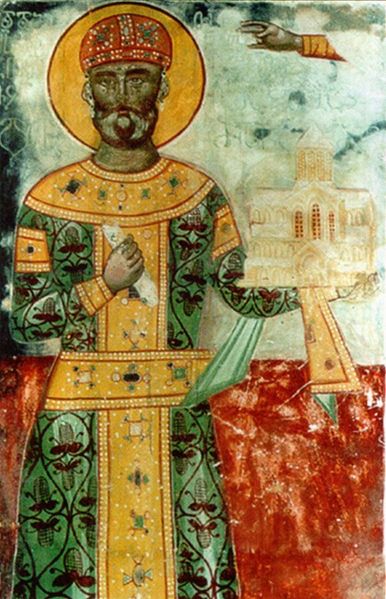
In 1103, King David convened the Ruis-Urbnisi Church Council that reformed the Georgian Orthodox Church, limiting its authority, expelling rebellious clergy, and expanding the royal oversight into clerical sphere. The office of the powerful Archbishop of Chqondidi was merged with that of Mtsignobartukhutsesi, chief adviser to the king on all state issues. The new office introduced direct royal authority over the church, supervised the new court system (saajo kari), and directed the police apparatus that spread royal authority throughout the kingdom. The king facilitated the construction of monasteries and churches in Georgia, Greece, Bulgaria, and Palestine. His most beloved project was the establishment of the Gelati Monastery and Academy in 1106, where he often personally labored on construction. Gelati, however, was not completed until after his death but eventually became a major educational and cultural center.